
How to Cycle a New Aquarium
When it comes to cycle new aquarium, you set up the tank, added sparkling gravel, and stood back thinking, “This looks like a fishy penthouse.” Then the internet whispered a sober truth: your aquarium needs to be cycled first. If you’re wondering how to cycle a new aquarium without stressing fish (or yourself), you’re in the right place. Think of cycling as growing a microscopic housekeeping team—beneficial bacteria—that eat fish waste before it can harm your pets. With a bit of patience, a few smart tools, and a simple routine, you can do this confidently. And yes, we’ll keep it practical, encouraging, and zero shame. You’ve got this!
Best Products
| Product | Best For | Why It Helps | Link |
|---|---|---|---|
| API Freshwater Master Test Kit | Accurate daily testing | Liquid reagents provide precise ammonia, nitrite, nitrate, and pH readings so you can track progress. | API Freshwater Master Test Kit |
| Seachem Prime | Protecting fish during cycling | Detoxifies ammonia and nitrite for 24–48 hours and neutralizes chlorine/chloramine. | Seachem Prime |
| Dr. Tim’s One & Only | Jump-starting bacteria | Seeds your filter with live nitrifying bacteria to shorten the cycling timeline. | Dr. Tim's One & Only |
| Python Water Changer | Frequent partial water changes | Makes quick, no-spill water changes easy, reducing stress on fish and you. | Python Water Changer |
| Fluval BioMax | Long-term biofiltration | Ceramic rings add high-surface-area homes for beneficial bacteria to colonize. | Fluval BioMax |
Related Articles You Might Enjoy
Why This Happens
New tanks don’t have the biological filtration that established aquariums rely on. Fish and decomposing food release ammonia, which is highly toxic even at low levels. In a healthy, “cycled” aquarium, colonies of beneficial bacteria transform ammonia (NH3/NH4+) into nitrite (NO2−), which is also toxic, and then another set of bacteria convert nitrite into nitrate (NO3−), which is far less harmful and can be controlled with water changes and live plants.
This is called the nitrogen cycle, and it doesn’t exist in a brand-new setup until you build it. In a new tank, there simply aren’t enough bacteria to process waste. Without cycling, ammonia and nitrite spike, fish get stressed, and things can go south fast. The goal of cycling is to cultivate strong colonies of these bacteria—mostly on your filter media and other surfaces—so they can neutralize waste as your fish produce it.
There are two main approaches:
- Fishless cycle: You feed the bacteria using an ammonia source (no fish yet). This is the most humane and easiest to control. It also builds a stronger biofilter from the start.
- Fish-in cycle: If fish are already present, you protect them with frequent water changes, detoxifiers, and careful feeding while bacteria slowly grow. It works, but requires vigilance.
Either route works if you stay consistent. The bacteria want to grow—your job is to make their world stable, oxygen-rich, and ammonia-fed (at safe levels).
What You'll Need for Cycle New Aquarium
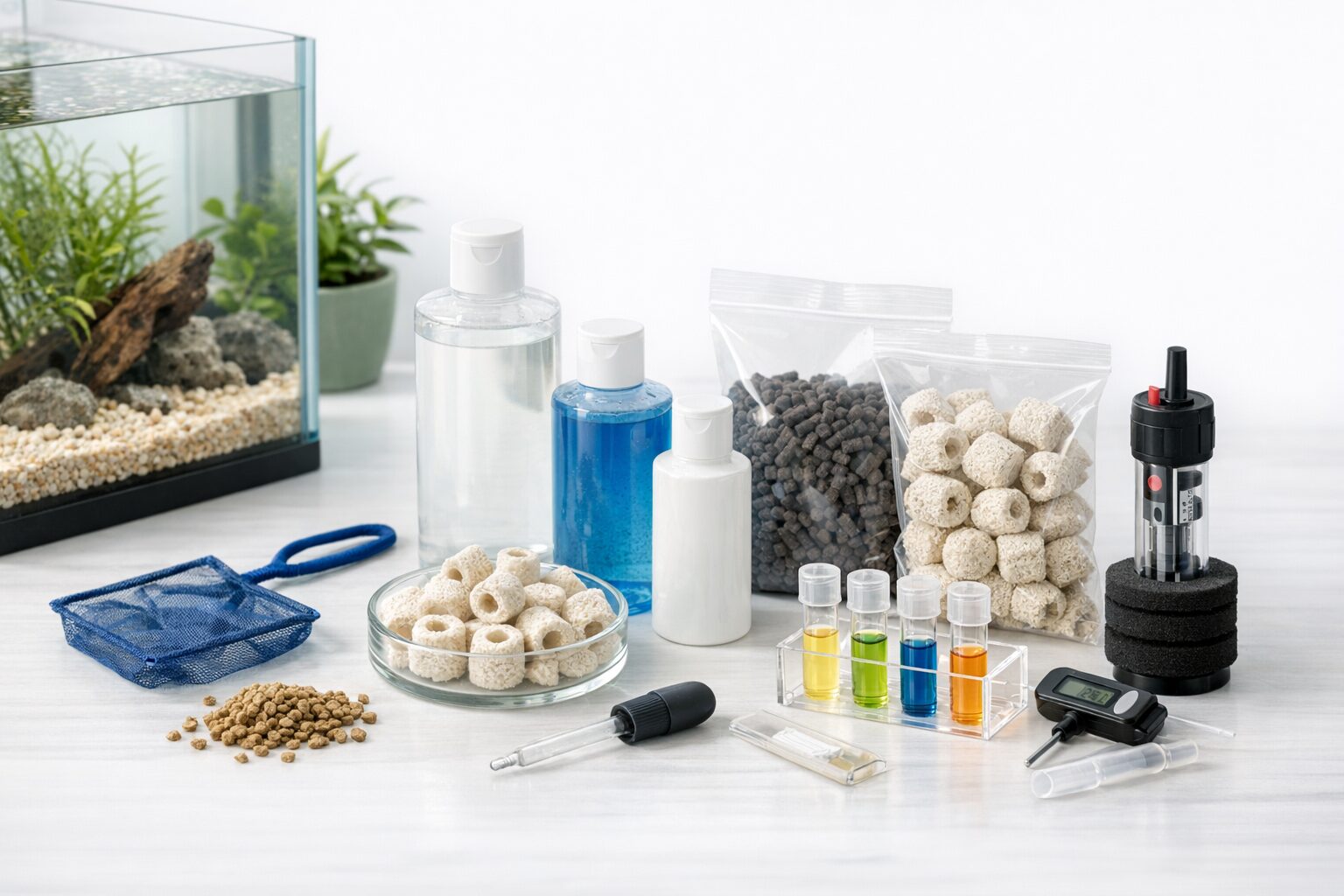
- Liquid test kit to measure ammonia, nitrite, nitrate, and pH accurately. API Freshwater Master Test Kit
- Water conditioner (dechlorinator) to remove chlorine/chloramine that would otherwise kill your new bacteria. Seachem Prime
- Bacterial starter to seed the system with live nitrifying bacteria. Dr. Tim's One & Only
- Pure ammonia or fish food as a controllable food source for bacteria (ammonium chloride preferred). Dr. Tim's Ammonium Chloride
- Filter with biomedia where bacteria can live (sponges, ceramic rings). Fluval BioMax
- Sponge filter or pre-filter sponge for extra bio surface and gentle flow. Aquarium Sponge Filter
- Heater to keep a stable temp (cycling is faster around 77–82°F/25–28°C). Eheim Jager Heater
- Thermometer to verify you’re actually at the temp you think you are. Digital Aquarium Thermometer
- Air pump and airstone for strong aeration; nitrifying bacteria love oxygen. Tetra Whisper Air Pump
- Gravel vacuum and bucket or water changer for easy water changes. Python Water Changer
- Alkalinity buffer or crushed coral (optional) if your water is very soft and pH keeps dropping. Seachem Alkaline Buffer
Step-by-Step Plan for Cycle New Aquarium
Step 1: How to cycle a new aquarium starts with setup—dechlorinate and prepare the environment for Cycle New Aquarium
Rinse your substrate and decorations (no soaps), assemble the filter with biomedia, install the heater and thermometer, and fill the tank with tap water. Dose a water conditioner as directed to neutralize chlorine/chloramine—this is critical because chlorine kills beneficial bacteria. Start your filter and air pump to ensure strong water movement and oxygenation.
Set the temperature to 77–82°F (25–28°C). Warmer water speeds bacterial growth. If you plan to keep cold-water species later, you can lower the temperature after cycling completes.
Optional but helpful: If you have access to an established, healthy tank, borrow some gunky filter squeezings or a piece of established bio-sponge to “seed” your new filter—this can cut cycling time drastically. Keep any borrowed media wet and dechlorinated in transit.
Step 2: Add a bacterial starter and give it a home for Cycle New Aquarium
Pour in a trusted bottled bacteria product as directed. These bacteria prefer to cling to surfaces, so make sure you’ve got sponge or ceramic media in the filter. Strong aeration helps them thrive because nitrifiers are oxygen-hungry. Don’t rinse biomedia in tap water and don’t turn the filter off for extended periods—starving the bacteria of oxygen can wipe out your progress.
Pro tip: Use dechlorinator any time you add tap water. A single unconditioned top-off can set you back days.
Step 3: Feed the bacteria with a controlled ammonia source for Cycle New Aquarium
For a fishless cycle, dose pure ammonium chloride to reach about 2 ppm ammonia on your test kit. If you can’t source pure ammonia, you can “ghost feed” with a small pinch of fish food; it will decompose into ammonia, but it’s harder to control and a bit smellier. Wait 30 minutes after dosing, then test to confirm your ammonia is around 2 ppm. If it’s higher than 3 ppm, do a partial water change to bring it down—too much ammonia can actually stall the cycle.
Keep the filter and air running 24/7. Record your test results in a simple log or note app. You’ll start by seeing only ammonia. In a few days to a week, nitrite should appear—this is your sign that the first team of bacteria is doing its job. Read more: How to Cycle a New Aquarium
Step 4: Test daily and keep ammonia trickling in Cycle New Aquarium
As soon as you detect nitrite, you’ve got the first milestone. Continue dosing enough ammonia daily to bring it back to about 1–2 ppm. The goal is steady food for bacteria, not feast-famine. If ammonia is still present after 24 hours, don’t add more—wait until it drops below ~0.5–1.0 ppm before topping up to 1–2 ppm again.
Meanwhile, nitrate will begin to appear as the second group of bacteria develops. This means you’re on the home stretch. Keep notes: a simple “A/N/N” log (ammonia/nitrite/nitrate) helps you spot trends.
Step 5: Nurture the nitrite stage and avoid stalls for Cycle New Aquarium
Nitrite can “plateau” or appear stuck at the top of your test scale (often a deep purple). If nitrite reads off the charts for several days, do a 30–50% water change to dilute it and maintain pH and alkalinity. High nitrite and low pH can slow bacteria. If your tap water is very soft, a small amount of crushed coral in the filter or a measured dose of buffer can stabilize pH around 7.0–7.8 during the cycle.
Continue adding a bacterial starter weekly if desired; it’s not mandatory, but many hobbyists find it helps establish a robust colony. Keep ammonia feeding gentle (1–2 ppm). Do not scrub the tank or replace biomedia at this stage.
Step 6: Confirm you can process a full day’s waste for Cycle New Aquarium
You’re considered “cycled” when your tank can process a known amount of ammonia to nitrate within 24 hours with both ammonia and nitrite testing back to zero. A good stress test: dose to 2 ppm ammonia, then test 24 hours later. If ammonia and nitrite are both 0 and nitrates increased, you’re ready.
Before adding fish, perform a large water change (50–80%) to bring nitrates below ~20–40 ppm. Condition the new water, match temperature as closely as possible, and keep your filter wet and running during the change.
Step 7: Add livestock slowly and keep testing for Cycle New Aquarium
Even after a fishless cycle, add livestock in stages. Introduce your first group of fish (about 25–50% of your final stocking), feed lightly for the first week, and test daily. If ammonia or nitrite spikes above 0.25 ppm, do a partial water change and reduce feeding. Add the next group after a week or two of stable readings. Live plants help mop up nitrate and smooth out small wobbles.
If you must cycle with fish in the tank, protect them with daily testing, frequent partial water changes (25–50% as needed to keep ammonia and nitrite below 0.25 ppm), and use a conditioner that detoxifies ammonia/nitrite for 24–48 hours. Seachem Prime Pair that with a quality bacterial starter and conservative feeding.
Common Mistakes to Avoid
- Adding fish too soon: If ammonia and nitrite aren’t both hitting zero within 24 hours after dosing ammonia, your biofilter isn’t ready.
- Overdosing ammonia: More than ~3 ppm can inhibit bacteria. Aim for 1–2 ppm during the build.
- Under-aerating: Nitrifiers need lots of oxygen. Add an airstone if your surface agitation is weak.
- Forgetting dechlorinator: Chlorine/chloramine can crash your cycle. Condition every drop of new water.
- Cleaning too aggressively: Don’t replace biomedia or rinse it under tap water. Gently swish in tank water during maintenance after the cycle is complete.
- Ignoring pH and KH: Very low alkalinity can let pH drop below ~6.5, slowing or stalling the cycle.
- Trusting dip strips alone: Strips are convenient but less precise. Confirm with a liquid test kit.
- Feeding heavily during fish-in cycles: Extra food becomes extra ammonia. Feed tiny portions once daily.
Troubleshooting for Cycle New Aquarium
My nitrite has been “off the charts” for a week
Extremely high nitrite can stall the process. Do a 30–50% water change to bring nitrite into a readable range. Ensure strong aeration and maintain your ammonia target around 1 ppm rather than 2 ppm for a few days. Keep pH stable; if it’s drifting below 6.6, consider a small buffer dose or crushed coral. Continue daily testing and resume normal dosing once nitrite begins to drop within 24 hours.
My pH keeps dropping and the cycle won’t finish
Nitrification produces acid, which consumes alkalinity (KH). In very soft water, KH can be depleted, letting pH crash. Add a source of buffering (a small bag of crushed coral in the filter or a measured dose of alkalinity buffer) and do a partial water change to restore minerals. Keep pH in the 7.0–7.8 range during cycling for best speed.
I dosed ammonia but bacteria never appeared
Double-check dechlorinator use; untreated tap water can wipe out bacteria. Confirm your ammonia source is pure ammonium chloride (scented household cleaners and surfactants are a no-go). Boost temperature to 77–82°F and add a fresh bacterial starter. Ensure your filter is running continuously with good flow. Finally, verify test kit freshness—reagents do expire.
I already have fish and ammonia is spiking
Do an immediate 50% water change, condition the new water, and add a detoxifier that binds ammonia and nitrite temporarily. Seachem Prime Reduce feeding to very small portions once daily. Add bottled bacteria and consider extra biomedia (a sponge filter is perfect). Test morning and evening until ammonia and nitrite consistently remain under 0.25 ppm.
My nitrate is zero even after weeks
No nitrate can mean the second group of bacteria hasn’t colonized yet, your kit is reading incorrectly, or you’re doing very large/frequent water changes that dilute nitrate below detection. Cross-check with a fresh test kit, confirm that nitrite is present (it should be if nitrate is still zero), and give it time. If nitrite has been high, do a partial water change to reduce it; that can help the nitrate-producing bacteria catch up.
How Long It Usually Takes
With a fishless cycle using bottled bacteria, strong aeration, and warm temperatures, most tanks take about 3–6 weeks to fully cycle. Seeding with established media can shorten this to 7–14 days. Cooler temperatures, low pH, or very high nitrite levels can lengthen the timeline. Fish-in cycles often run 4–8 weeks because you must keep waste levels ultra-low to protect fish, which slows bacterial growth.
It’s perfectly normal to experience a bacterial “bloom” (cloudy water) around weeks 1–3. This clears on its own as the biofilter stabilizes. The finish line is when a 2 ppm dose of ammonia is processed to nitrate within 24 hours with ammonia and nitrite reading zero and nitrate going up. Then you do a large water change, add fish gradually, and keep testing for the next week or two.
When to Get Professional Help
- Persistent fish distress: Gasping at the surface, clamped fins, or repeated losses despite water changes and detoxifier use call for help from an experienced aquarist or aquatic vet.
- Stalled cycle for 2+ weeks: If nitrite or ammonia refuses to budge and you’ve addressed pH/KH and aeration, consider consulting a local fish store pro to test your water and confirm your kit’s readings.
- Unusual source water: Well water with high ammonia or extreme pH/mineral content can complicate cycling. Local experts can recommend tailored buffers or pre-treatment.
- Complex setups: Planted high-tech, brackish, or specialized biotopes may need nuanced approaches to filtration and cycling.
FAQ
Do I need fish to start the cycle?
No. In fact, the fishless method is best. You feed bacteria with a controlled ammonia source, avoid harming fish, and usually build a stronger, more forgiving biofilter.
How often should I test during cycling?
Daily is ideal. Record ammonia, nitrite, and nitrate. Once the tank processes 2 ppm of ammonia to zero ammonia and zero nitrite within 24 hours, you’re done.
Will live plants help or hurt the cycle?
Help! Plants use ammonia and nitrate, stabilizing water and reducing final nitrate buildup. Just know very fast-growing, heavily planted tanks may show lower readings because the plants are “eating your homework.” The biofilter still develops—often more gently and quickly.
Can I run lights and add decorations during the cycle?
Yes. Decorations and substrate provide surfaces for bacteria. Lights are optional; they won’t affect cycling but can promote algae if left on too long without plants.
Is it safe to clean the filter during the cycle?
Avoid it unless flow is severely reduced. If you must, gently swish the sponge or media in a bucket of tank water (never tap water) to preserve bacteria.
What stocking level can I add after a fishless cycle?
If your tank consistently processes 2 ppm ammonia in 24 hours, it can typically handle a moderate initial stock. Still, add fish in stages (25–50% of your plan at a time) and keep testing for a week after each addition.
Learning how to cycle a new aquarium is really just learning to care for an invisible workforce. Give them oxygen, stable pH, and a measured trickle of ammonia, and they’ll repay you with clean, safe water for years. Start patient, stay curious, and soon you’ll be the friend everyone texts for fish-keeping advice.